
 The 18th Polar Law Symposium (PLS) brought together a wide range of participants in Nuuk to address contemporary inquiries in the polar regions. As an academic discipline, polar law provides a unique platform to adopt intra- and interdisciplinary approaches and the symposium operates as an important space for collaborative research, peaceful dialogue, networking, and creativity. Since international cooperation remains the cornerstone of international law, the opportunity to meet with professionals in the field is a critical necessity, particularly in times of heightened political tension. Through mutual interaction and knowledge transfer, the symposium facilitated cooperation between academics, practitioners, and peoples originating from various places in the Arctic. The event promoted bond-creation, contact exchange, strategy-building, and the development of future governance. It allowed for the reaching of agreement and consensus, or at the very least, a minimum understanding of differing positions. This serves as a powerful demonstration of how science remains a mostly peaceful activity that can bridge borders despite turbulence in geopolitics. The diversity of profiles represented – scientists, institutional representatives, professors, and students – was a major strength of the gathering.
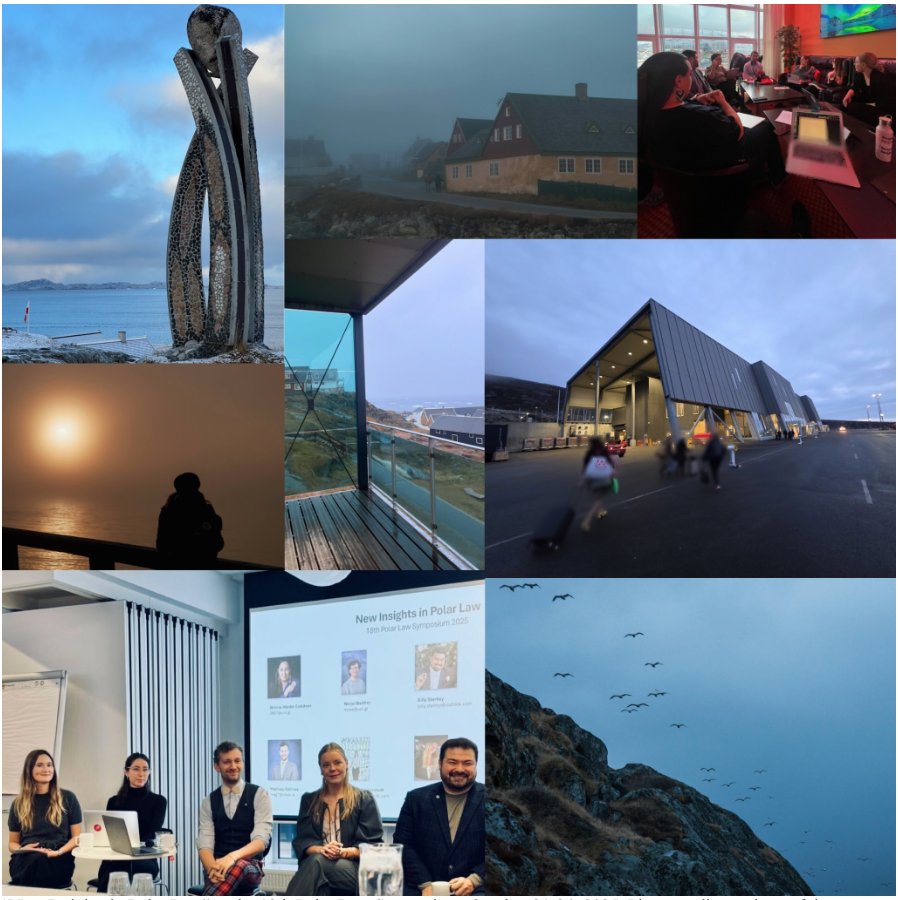
“New Insights in Polar Law” at the Polar Law Symposium 2025
For the next generation of academics and practitioners, the experience was defined by the connections made in divisive times. Thanks to the financial support of the International Arctic Science Committee (IASC), a group of polar law students from the University of Akureyri (Háskólinn á Akureyri) – Mathieu Gélinas, Jolanda Lipu, Emma Lipoff, Billy Starkey, and Katarina Wallerstedt – traveled to Nuuk to participate in an early career scholar led panel titled “New Insights in Polar Law.” The panel represented students from diverse academic, professional and personal backgrounds, and additionally, included collaboration with five students from Ilisimatusarfik (University of Greenland). Together, this group from the University of Akureyri and Greenland explored a wide range of topics:
- Critical examination of foundational assumptions and legal constructions in polar law.
- Questions of consent, enforceability, and the limits of international law.
- The role of Inuit water governance within Canada’s Arctic and foreign policy frameworks.
- Canada–Greenland relations and the links between polar law and other legal fields.
- Misuse ofIndigenous heritage in marketing and communication.
- Perspectives on legal education in Greenland and Denmark.
- Future outlooks for polar law and Greenland.
Early Career Scholarly Reflections
From an early career scholarly perspective, the symposium was an opportunity to deepen knowledge, practice communication skills, and develop lasting friendships and colleagueships. We left the conference with a renewed sense of purpose and a commitment to the ongoing dialogue that polar law demands. As students, we often deal with concepts that portray structured “truths” – formulas developed in their particular context. However, the panels of the symposium made it clear that the issues of the polar regions are more variable and nuanced than they may appear at first sight. Speakers demonstrated that certain norms and practices might prove difficult to apply, or even unsuitable, when confronted with emerging geopolitical and environmental challenges. We learned that theory is a foundation that must be continually revisited and adapted to contemporary realities, in constant change. Practice is not a simple matter of "copying and pasting" theory, but of approaching it critically and flexibly. The symposium revealed the reality of theory in practice, particularly through sessions focused on the environment, the future of Greenland, and the impacts of global tensions in polar law.
Concluding Remarks
The 18th PLS offered an extraordinary opportunity to bring professionals together to discuss the future of the polar regions. The experience greatly enriched us participants by consolidating past and present perspectives, thus paving the way for new insights and knowledge. The symposium is however not limited to the production of knowledge; it is a genuine space for the advancement of scientific, legal, and social research and interaction between peoples. While the long-term impacts of the symposium may be challenging to quantify, it is safe to conclude that it plays a fundamental role for connections, inspiration, and impetus for academics and practitioners. On a professional level, it reinforced the conviction that possibilities for scientific conferences are essential for the evolution of the field. However, we noted a relatively low representation of private sector actors and locals. In future sessions, particularly those regarding the environment, it would be beneficial to hear more on the perspectives of the Peoples directly affected as well as corporate impacts to ensure a more balanced debate between actors active in the field.
Executive Highlights
- Bridging Theory and Practice:The symposium underscored that traditional legal theories must be iteratively adapted to the unique geopolitical and environmental realities of the poles. Participants identified that "theoretical rigor" alone is insufficient for addressing Arctic governance, necessitating a shift toward flexible, critical applications of law that account for rapid local, regional and global changes.
- Interdisciplinary Arena:Polar law functions not in silos but as a cross-cutting discipline. By integrating perspectives from climate science, social sciences, and Indigenous knowledge, the PLS demonstrated that effective polar governance requires knowledge transfer between academics, practitioners, and the local communities who call Arctic territories their home.
- Science Diplomacy:Despite the current global geopolitical instability – in the North and beyond - the PLS served as a vital "peaceful space" for international cooperation. It proved that scientific and legal exchange can foster consensus-building and maintain essential communication channels between Arctic and non-Arctic stakeholders during periods of high political friction.
Photo credit: Mathieu Gélinas, Jolanda Lipu, Emma Lipoff, Billy Starkey and Katarina Wallerstedt (University of Akureyri).
Date and Location
October 21-24, 2025| Nuuk, Kalaallit Nunaat (Greenland)
IASC Working Groups funding the project
- Marine WG
- Social & Human WG
- Terrestrial WG
Project Lead
Rachael Lorna Johnstone (University of Akureyri, Iceland)
Year funded by IASC
2025