

The Saroma sea ice school (Biogeochemical exchanges at Sea Ice Interfaces - BEPSII - CATCH Sea-Ice School 2026) was held from 28 Feb to 9 March 2026, Saroma, Japan aiming at building capacity for sustainable multidisciplinary science at the Ocean- Ice- Snow-Atmosphere (OISA) interface. The school was designed to equally represent ocean, sea ice and atmospheric science components through lectures, field and laboratory components and modelling exercises.
A key goal was to develop a base understanding of all components of this interdisciplinary field at an early career stage and facilitate cross-collaboration in the future. This also includes establishing connections, friendships and shared memories to increase the comfort level when trying to reach out across disciplines over the course of the ECRs career. This cross collaboration is extremely important as OISA processes remain insufficiently understood and inadequately parameterized in climate models. These limitations lead to biases and inaccuracies in polar climate projections, and are in part driven by long-term siloing of the disciplines. In addition to the OISA science components, complementary teaching components were designed to support early career researcher training and career advancement. Accordingly, the school included lectures and workshops on Indigenous traditional knowledge, knowledge co-production and two-eyed seeing, science communication, time management and publication strategies.
The feedback to the school was extremely positive and allowed 29 ECRs to experience this focused training. Several students had not seen sea ice before and specifically never set foot on sea ice, making this an even more memorable experience.
The school was co-organized by BEPSII (Biogeochemical exchanges at Sea Ice Interfaces - About us) and CATCH (Home), who consolidated their efforts in the SCOR working group Cice2Clouds (CIce2Clouds), which focuses on synthesizing and advancing OISA research and capacity. The school was the final element of the working group’s terms of reference and the school was closed off by the Cice2Clouds hybrid meeting in Shiretoku, Japan. Several Saroma school students attended the meeting and participated in discussions of future collaboration within the OISA community.
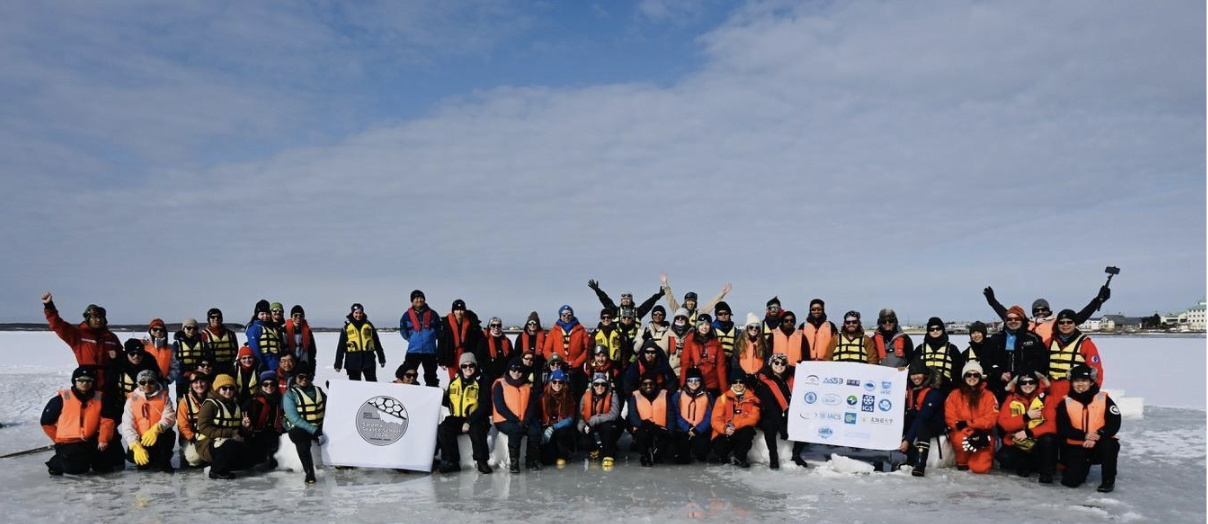
In advance of the school a 200+ pages of school textbook was created, largely building on a OISA tutorial paper currently being finalized by the Cice2Clouds WG. The school received 208 applications from 45 countries. The selection was extremely difficult to due to so many deserving candidates. In the end 30 students were selected from 17 countries. The extensive educational program was held by 19 lecturers, with field support from 8 students out of the host institution in Japan (Daiki Nomura, Hokkaido University). The program contained 17 hours of lectures on 11 topics, 16 hours in the field and 15 hours in the lab on the 5 main topics, where 5 groups rotated through each topic over the course of the week. 11 hours of poster sessions and networking (including karaoke!). The 5 groups were supported by 5 mentors and each group prepared a final presentation, each on one of the 5 larger topics (selected by draw). A special event was a live call with colleagues on RV Polarstern in the Weddell Sea, which was particularly engaging as the senior researchers in the field talked about doing exactly the measurements in the field the students were learning in the school.
Five main organizers (D. Nomura, B. Delille, J. Creamean, O. Crabeck, L. Tedesco) drove the local planning, general coordination, budget allocation, student selection, communication with sponsors etc. with support from many more to help with details and funding applications. In addition to the reporting to our sponsors a peer-reviewed report is in preparation for “Ocean Education” in Oceanography. The participation of a communications expert, Yann Ilunga, KoineComm, allowed for dozens of hours of recordings, which are currently being turned into tutorial videos. Students and lectures were also being treated to occasional video summaries which were then posted through various communication channels.
In the name of BEPSII, CATCH and Cice2Clouds, the organizers, lecturers, and students are extremely grateful to all sponsors: Hokkaido University, Arctic Challenge for Sustainability, European Geophysical Union, European Polar Board, Green Feedback, International Arctic Science Committee, International Glaciological Society, International Association of Cryospheric Sciences, European Union, Kakenhi, International Union of Geodesy and Geophysics, Meopar, North Pacific Science organisation (PICES), Scientific Committee on Ocean Research, Scientific Committee on Antarctic Research, Surface Ocean Lower Atmosphere Study.
Highlights
- 29 early career scientists were trained in sustainable multidisciplinary science at the Ocean- Ice- Snow-Atmosphere (OISA) interface. The program contained 17 hours of lectures on 11 topics, 16 hours in the field and 15 hours in the lab on the 5 main topics, where 5 groups rotated through each topic over the course of the week. 11 hours of poster sessions and networking
- In addition to the OISA science components, complementary teaching included lectures and workshops on Indigenous traditional knowledge, knowledge co-production and two-eyed seeing, science communication, time management and publication strategies.
- The participation of a communications expert allowed for dozens of hours of recordings, which are currently being turned into tutorial videos
Date and Location
Saroma-Ko lagoon, Japan | 28 February – 11 March 2026
IASC Working Group funding the Project:
Project Leaders:
Nadja Steiner (Department of Fisheries and Oceans Canada, Canada)
Year funded by IASC:
2025