

Glaciers and their retreat pose severe hazards for people and infrastructure in the Arctic. Such risks are climate-dependent and increase with human activities expanding into regions prone to glacier hazards, such as the Arctic. Glacier hazards, such as floods (e.g. glacier outburst floods and collapsing icedammed lakes), retreat-induced land-slides and rockfalls, ice-berg calving and drift, and glacier surges affect Arctic communities, infrastructure, tourism and industry.
 Glaciers and their retreat pose severe hazards for people and infrastructure in the Arctic. Such risks are climate-dependent and increase with human activities expanding into regions prone to glacier hazards, such as the Arctic. Glacier hazards, such as floods (e.g. glacier outburst floods and collapsing icedammed lakes), retreat-induced land-slides and rockfalls, ice-berg calving and drift, and glacier surges affect Arctic communities, infrastructure, tourism and industry.
In a cross-cutting activity on “Arctic glacier hazards”, we aim to bring together glaciologists, social scientists, atmosphere scientists, terrestrial researchers, and representatives from Arctic (Indigenous) communities to identify key glacier hazards, analyze the physical processes involved, discuss exposure and vulnerability of Arctic society in a present and future climate, and establish future research directions.
The cross-cutting activity will be implemented in the annual IASC Network on Arctic Glaciology (NAG; http://nag.iasc.info) in connection to the “Workshop on the Dynamics and Mass Budget of Arctic Glaciers” in Obergurgl, Austria, in January 2026.
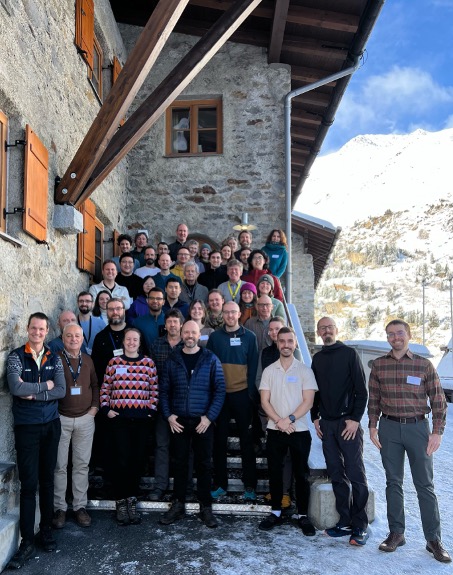
Thanks to the generous support of the Cryosphere, Atmosphere, Social and Human and Terrestrial Working Groups, we were able to have the IASC Network on Arctic Glaciology (NAG) workshop & cross-cutting activity on Arctic glacier hazards in the high-alpine village of Obergurgl, Austria, on 26-28 January 2026. The meeting attracted 46 in-person participants from 11 countries including glaciologists, social scientists, atmospheric scientists, and terrestrial scientists. A livestream ran throughout the meeting and was viewed by up to 58 registered participants. The meeting program included 28 oral presentations, a poster session with 13 posters, a cross-cutting discussion session on glacier hazards, and the NAG open forum where, among other topics, future NAG activities were discussed. In total 14 presentations contributed directly to the cross-cutting activity. Keynote presentations were given by Steph Matti (on sudden, mid-range and long-term Arctic glacier risks) and Matthias Huss (on trends in glacier collapses, land-slides and avalanching).
Their presentations and other cross-cutting presentations discussed the following main themes (lead presenters indicated in parentheses):
- Glacier discharge and lake outburst floods (Steph Matti, Armin Dachauer, Daniel Binder, David Polashenski, Justyna Dudek, Bryan Cantal, Baojuan Huai, Andreas Ahlstrøm)
- Glacier surging (Benoit Lauzon, Luke Copland, Justyna Dudek, Wesley Van Wychen)
- Glacier collapses & land-slides (Matthias Huss, Gabriel Wolken)
- Avalanches & tourism (Matthias Huss, Bernhard Hynek, Shoudong Zhao)
During the cross-cutting discussion session, meeting participants were split into three groups to discuss 1) glacier related slope instabilities and glacier collapses, 2) glacier lake outburst floods (GLOFs), and 3) glacier surges, which led to stimulating discussions among the participants about the current state of research in these fields and future directions. A more detailed summary of these discussions is included in the Meeting report and abstract book (p 11-13). The first group, discussing slope instabilities and glacier collapses was led by Matthias Huss found that future research should focus on improved process understanding, and establishing a more complete database of past events. It was further acknowledged that large-scale detection needs to be improved, that local and national authorities should be supported with fundamental knowledge, and that local knowledge about hazard conditions should be better utilized. The second group, discussing GLOFs, led by Steph Matti, argued that improved numerical model and targeted observational data are required to further process understanding and develop better GLOF warning systems. Furthermore, as in group 1) it was argued that a more comprehensive and harmonized database of events is needed, potentially generated with the help of machine learning. Scientific research should support local authorities to identify and monitor high-risk sites, and implement risk management strategies such as early warning systems, evacuation plans and structural measures. A third group, with a focus on surging, led by Hester Jiskoot, argued that a recent study by Lovell et al. (2026) presents an important new more complete database of surging glaciers, now also containing information on related hazardous events. The group identified six main hazard mechanisms: 1) glacier advance, 2) GLOFs from ice-dammed lakes, 3) subglacial lake outburst floods, 4) glacier detachments, 5) increased crevassing, and 6) enhanced calving. Scientific research should focus on assessing how climate change may shift the frequency of surges and the regions experiencing them. E.g. the Canadian and Russian might become more conducive to surging. Modelling and observations, both using remote-sensing and ground-based data, should be combined and internationally coordinated efforts are needed to develop standardized approaches to ingesting new databases of surge-type glaciers and hazards. After the group discussions, the group leaders summarized the main discussion points in short presentations for all participants.
Connected to the previous activity, we have proposed a new activity entitled “From snowflakes to floods: Arctic glacier hydrology and downstream impacts” to be conducted at the next IASC NAG meeting in Hafjell, Norway in February 2027, for which we hope to receive support from the IASC Cryosphere, Atmosphere, Terrestrial and Marine WGs.
Highlights
- Two invited presentations on 1) sudden, mid-range and long-term Arctic glacier hazards (Steph Matti) and 2) risk management of glacier collapses, avalanching and land slides (Matthias Huss)
- Cross-cutting oral and poster presentations presenting state-of-the-art research on a range of Arctic glacier hazards (GLOFs, surging, glacier collapses and retreat-induced landslides, avalanches) and their societal impacts.
- Dedicated session with Cross-cutting group discussions on slope instabilities and collapses, GLOFs, and surging, helping to shape directions for further research and develop new ideas for databases, risk management, development of early-warning systems, and communication and data sharing with local and national authorities.
Date and Location
26-28 January 2026 | Obergurgl, Austria
IASC Working Groups funding the project
- Atmosphere WG
- Cryosphere WG
- Social & Human WG
- Terrestrial WG
Project Lead
Ward van Pelt (Uppsala University, Sweden)
Year funded by IASC
2025