

“[…] The greatest problem I see for science currently is the expectation of a high frequency of scientific output in combination with shortened project lengths (max. 2 years). This puts scientists (and journal reviewers) under extreme time pressure, where it is necessary to compromise on scientific quality and rigor to reach the required publication goals. In the foreseeable future, this will lead to floods of insignificant publications, further decreasing the credibility of science in the wider populace.” [Respondent, SuP survey]
In this workshop we discussed the mismatch between the high ambitions of polar research on the one hand and the increasing stressors science practitioners are experiencing on the other hand. We fully support these high ambitions but wanted to ground them in the current context of these stressors. We did so by presenting the first results of the Science under Pressure survey that was conducted in 2025. In this report we present some of the most important results of the workshop, including a few survey results. We are currently working on a scientific article to present the complete results of the survey.
The survey was filled in by more than 365 polar researchers with a bias towards female researchers and European researchers, see graph below.
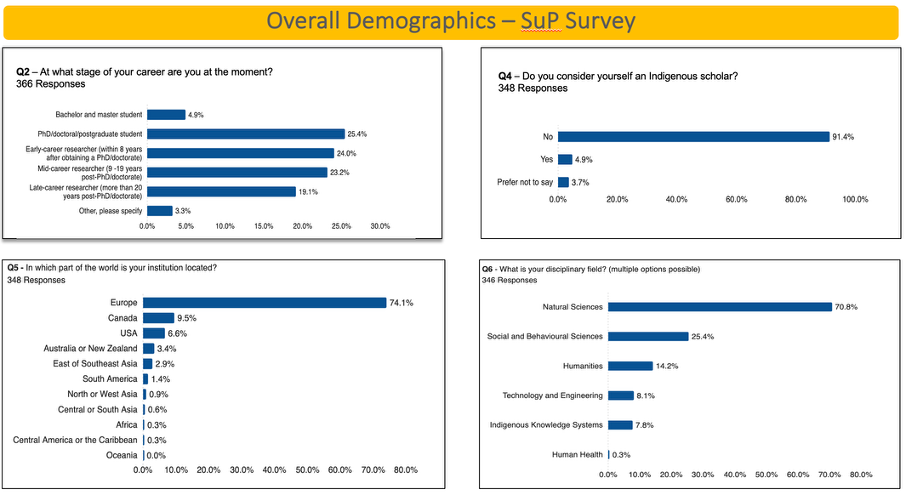
During the workshop we presented the results of the survey organized into five themes. For each theme we invited experts to give some personal reflections on the survey results followed by questions from workshop participants. After all of the presentations we invited all of the participants to answer 4 questions via Mentimeter, followed by an overall discussion.
We hereby give a short summary of the answers that were provided in the Mentimeter.
- What surprised you most with regard to the results?
What was mentioned the most was the fact that so many researchers (82% of our survey respondents) have data that has never been processed. To be able to analyse this unused data, additional funding is needed and most researchers regard it as difficult to obtain this money.
- What should be done to tackle the challenges that were identified in the survey?
Here the input was more diverse, but it can be summarised as follows:
- Policy and Funding: Advocate for systemic changes in funding structures, prioritizing long-term funding stability and collaboration.
- Community Building: Strengthen networks among researchers, Indigenous scholars, and institutions to amplify collective voices for better working conditions and structures in Polar research.
- Workplace Reform: Push for transparent, equitable workloads and career development opportunities.
- Public Engagement: Bridge the gap between research and society by emphasizing the relevance of scientific work to global challenges.
- What do you think is the most important recommendation for the IPY-5 organization to improve polar research conditions? (apart from more funding)
We selected a few of the answers:
- Try to find other success factors not only based on metrics and numbers (e.g., collaborations, outreach, community impacts)
- Advocate for longer-term funding, both for institution-based researchers and Indigenous community-based researchers
- Make use of already existing data
- Establish long-term collaborations exceeding IPY-5, which also requires long-term job opportunities
- Take alternative forums (such as this workshop) and voices seriously.
- How should we communicate these results and recommendations with the science policy and polar research communities?
Besides using IASC as a forum, it was clear that the audience thought these results should be communicated to funding agencies and other policy bodies working at different scales.
Highlight 1: The main negative stress factor for researchers with a temporary position is uncertain future prospects, while the main negative stress factor for researchers with a permanent position is administrative workload.
Highlight 2: The audience was most surprised by the fact that many researchers have collected data in the past that have never been analysed due to a lack of resources. There is a strong need/wish for research funding grants for analysing already existing data.
Highlight 3: The results of the survey and the stories of the presenters were very recognisable for the audience. Many think we need to communicate more with those in power for a more systematic change in how science is organised.
Date and Location
ASSW2026, Aarhus-Denmark
IASC Working Groups funding the project
- Atmosphere WG
- Cryosphere WG
- Marine WG
- Social & Human WG
Project Lead
Annette Scheepstra (University of Groningen, Netherlands)
Year funded by IASC
2025