

The first ARCPaC Conference was held in Aarhus, Denmark, from 25–29 May 2026, bringing together 115 researchers from 18 countries for a week of scientific exchange, networking, and community building. With 99 scientific abstracts, 36 oral presentations across six sessions, 58 poster presentations, and three keynote lectures, the meeting exceeded expectations and highlighted the strength and diversity of the Arctic paleo research community. A particular highlight of the conference was the strong participation of early-career researchers (over half of participants!), who contributed substantially to both oral and poster sessions and played an important role in shaping discussions throughout the week.
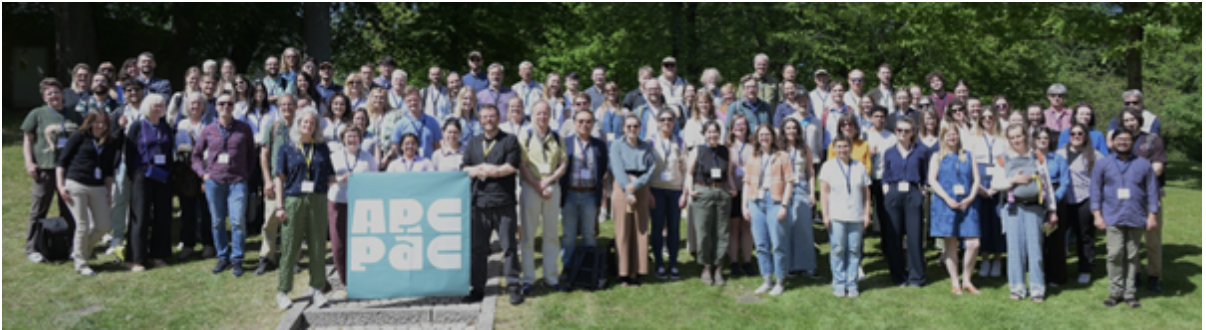
The conference kicked off with an icebreaker reception on Monday evening, held at the Department of Geoscience, Aarhus University (AU), while the main meeting took place a few buildings further up the road at AU’s Aarhus Institute of Advanced Studies (AIAS). A dedicated social event for Early Career Researchers was organized on Tuesday evening to promote networking. The early career researchers were invited to enjoy the evening with burgers and minigolf in downtown Aarhus which was very well received. A mid-week excursion to Djursland complemented the scientific program and offered participants an opportunity to experience the local Quaternary geology. The main scientific program reflected the broad scope of the ARCPaC network and included the following major themes:
- Greenland Ice Sheet and Arctic ice-sheet and glacier dynamics
- Glacial geomorphology and landscape evolution
- Carbon cycling and ecosystem responses to climate change
- Arctic and North Atlantic paleoceanography
- Sea-ice variability and ocean–ice interactions
- Chronology and proxy development
Keynote speakers
The three invited keynote speakers, Kelly Hogan (British Antarctic Survey), Janne Flora (Aarhus University), and David Harning (University of Colorado Boulder), covered an incredible variety of topics. This included the retreat dynamics of marine-terminating glaciers in Greenland based on glacial morphologies on adjacent shelves, the importance of and insights from co-created research with Indigenous communities in Greenland, along with ethical considerations when working on Indigenous land, and Holocene carbon sequestration dynamics and their environmental controls in Arctic lakes. Their presentations provided a lot of food for thought and discussion and highlighted key topics within the ARCPaC community moving towards the 5th International Polar Year.
Mid-conference excursion
The mid-conference excursion saw ~100 delegates travel to a very sunny Djursland to visit a series of sites demonstrating excellent evidence of the Weichselian glaciation of eastern Jutland, led by Jan Piotrowski and Anders Damsgaard. We saw sedimentary evidence for two ice advances at gravel pits in Balle, recording the main ice advance (which reached the Main Stationary Line) and a subsequent readvance from the southeast (the “Young Baltic” ice advance), along with large numbers of frost-cracked cobbles, indicating permafrost conditions following ice retreat. Following this we spent a while debating the origin of the Ebeltoft Till, a subglacial till reaching 9 m thick in places, deposited by the Young Baltic advance around 18 ka.
After a lunch stop in Ebeltoft (and some excellent ice cream) we headed to the viewpoint at Agri Bavnehøj to look over both Ebeltoft Vig and Kalø Vig. Here we discussed the formation and history of Kalø Vig, the formation of the glaciotectonic complex on which we were stood, and the use of geophysical methods to better understand subsurface sediment properties, and regional Quaternary history.
Conference dinner
The conference dinner took place on Thursday evening in Den Gamle By, an open-air museum showcasing Danish urban history with over 75 historic buildings from the 16th to the 21st Century. Here ~95 conference participants had a very nice dinner in the old Hestestalden (the old horse stables).
Early-career awards
Among many excellent talks and posters presented during the week, several contributions were recognised with awards. The award for best PhD Researcher poster went to Jakob Hamann (UiT, The Arctic University of Norway) for his work on geomorphic signatures of Late Weichselian ice shelves in Svalbard. The best PhD Researcher talk award was presented to Caroline Brand (Aarhus University) for her presentation on quantifying Quaternary sediment deposits on Greenland’s margin. The best Early Career Researcher talk was awarded to Inda Brinkmann (Stockholm University) for her work on DNA recording effects of climate change and permafrost thaw on the Canadian Arctic ecosystem. The best Early Career Researcher poster was presented by Mathia Sabino (Institute of Polar Sciences, Bologna) on reconstructing Greenland’s ecosystems and environments from basal ice.
Local organizing committee
The local organizing committee consisted of researchers from the Department of Geoscience, Aarhus University, and the Geological Survey of Denmark and Greenland (GEUS). The committee included Christof Pearce, Caroline Brand, Vivi Kathrine Pedersen, Timothy Lane, Henrieka Detlef, Lis Allaart, and Anders Damsgaard, who coordinated the scientific program, logistics, communication, and field excursion.
Funding and acknowledgements
The local organizing committee would like to thank all participants, session conveners, keynote speakers, and volunteers who contributed to the success of the conference. Special thanks go to AIAS for hosting the event and to GEUS and the Department of Geoscience, Aarhus University, for their support and contributions to the organization of the meeting. We gratefully acknowledge financial support from the Carlsberg Foundation, iClimate (AU Interdisciplinary Cluster for Climate Change), the International Arctic Scientific Committee (IASC), and the Geological Society of Denmark (DGF), whose support helped make the first ARCPaC Conference possible.
Date and Location
26 – 29 May 2026, Aarhus, Denmark
IASC Working Groups funding the project
- Cryosphere WG
- Marine WG
- Terrestrial WG
Project Lead
Henrieka Detlef (Aarhus University)
Year funded by IASC
2026